
Searching for a Warrant in Lincoln County
There is no single public Lincoln County warrant database in the sources reviewed. For county Circuit, Criminal, General Sessions, and juvenile clerk functions, start with the Circuit Court Clerk. A Fayetteville, Ardmore, or Petersburg citation may belong to that city’s court instead. Ask the office what public status it can confirm and what record request it accepts.
Have the court name, your case or citation number if known, and the date on the notice. Do not treat a same-name result as a match. Ask the clerk whether status can be checked by phone or requires a written or in-person request. A payment vendor is not a status search, and a blank website cannot establish that process is absent.
- Read the citation or court notice and identify the city, county court, or federal court named on it.
- For Lincoln County trial-court process, call the Circuit Court Clerk and ask which court holds the case.
- For a city citation, contact Fayetteville Municipal Court, Ardmore City/Recorder’s Court, or Petersburg City Court.
- Use the Sheriff’s Office for service or custody questions, then ask the clerk about a public docket or records request.
- For a federal matter, use the Eastern District of Tennessee clerk or PACER; consult counsel about your own case.
Lincoln County Clerk Starts Warrant Search
The Tennessee Administrative Office of the Courts directs warrant, arrest, and trial questions to the court clerk for the county where the case began. The Lincoln County directory places Circuit, Criminal, General Sessions, and juvenile clerk work with Lisa Simmons’s office. Chancery records use the separate Clerk & Master. A clerk can route the question, but access to juvenile, sealed, or investigative details may be limited.
The AOC Lincoln County clerk directory is the statewide court-system contact listing. Its screenshot shows the office directory, not a warrant search.
Use the listed court role to choose the right office before sending a request.
Lincoln County Warrant Clerk Finder Is Not a Search
The AOC’s Find a Court Clerk instructions route warrant, arrest, and trial questions to the clerk for the county where the matter began. That page helps identify the responsible office; it does not query Lincoln County’s docket. If the case began in a city court or federal court, identify that jurisdiction before relying on a county directory result.
Read the AOC clerk-finder instructions and use the listed court role to make a focused status or records request.
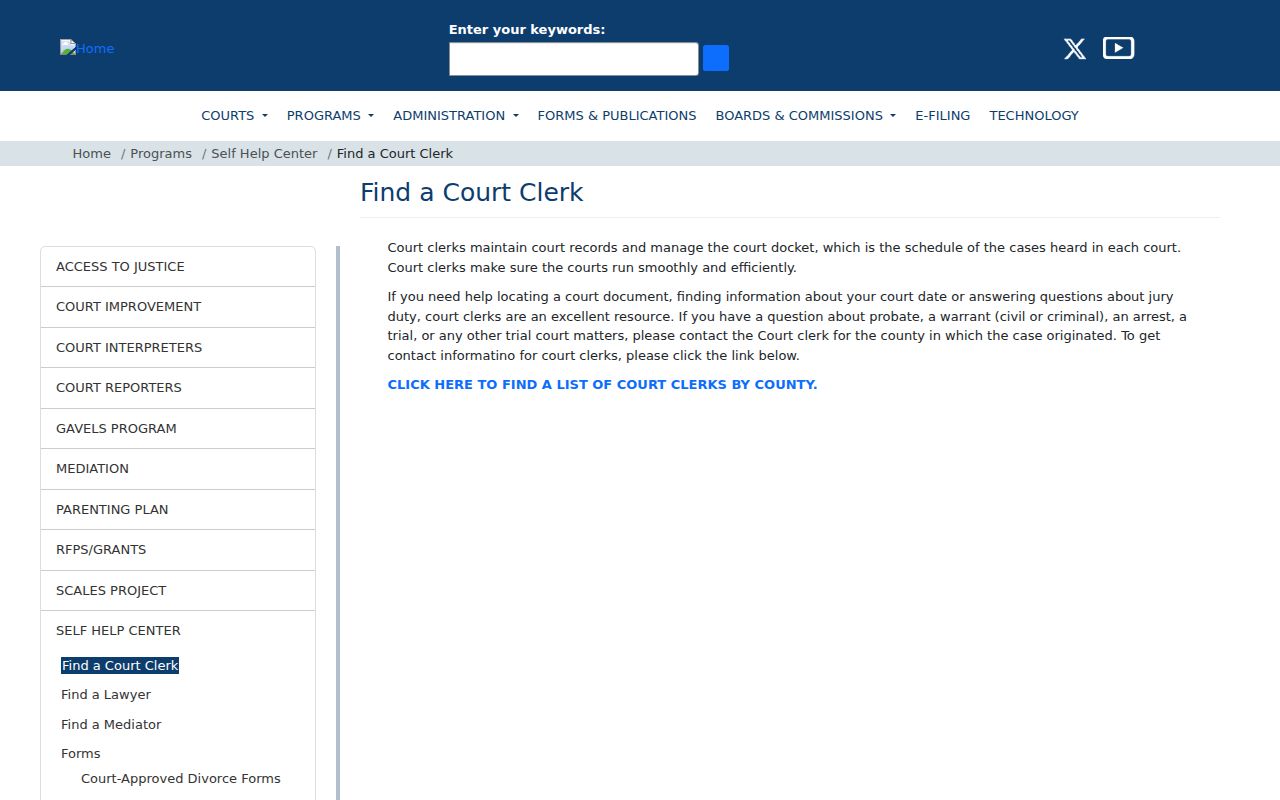
The statewide clerk-finder explains where to ask, not whether a warrant exists.
Warrant Search Fields Explained
No official Lincoln County public warrant form was located, so there are no local name, date-of-birth, court, or warrant-number fields to list. The table distinguishes the interfaces that were checked. It prevents a reader from mistaking a public but unrelated search box for county warrant access.
| Field Label | Type | Required | Notes |
|---|---|---|---|
| Lincoln County sheriff | No public form | Not applicable | Official site reviewed; no warrant search or list observed. |
| County trial court | Clerk contact | Not applicable | Ask the clerk what identifier is needed for a public status inquiry. |
| Appellate case history | Case number, case style, party name, business | Visible | Appeals only; not a Lincoln County trial-warrant search. |
| CourtFeePay | State and county selection | Visible at landing | County-linked court-cost payment route, not a warrant search. |
| TNCRIM | Login or registration | Restricted | Law-enforcement system, not a public lookup. |
Lincoln County City Warrant Search Routes
A city name does not identify the county court that owns a record. Fayetteville has a Municipal Court clerk and a separate nCourt ticket-payment page. Ardmore’s local materials use City Court and Recorder’s Court terms, with a published calendar but no warrant search. Petersburg lists a City Court clerk through the AOC and a Town Hall route. None of these pages exposed a public warrant roster.
Ardmore spans Giles and Lincoln Counties and sits on the Tennessee-Alabama line. Petersburg spans Lincoln and Marshall Counties. Confirm the issuing court and state before asking for a file. If a city source cannot route the question, call the city clerk or City Hall and identify the citation or court date.
What a Warrant Search Shows
Because no public Lincoln County warrant search was found, there is no local result screen or sample record to reproduce. A clerk may be able to confirm a public docket event without releasing the full warrant or affidavit. Ask for each record type by name, and request a non-exempt portion when a document is restricted.
| Case or citation number | Use the identifier on your own notice if the clerk requests it; no county format was published. |
|---|---|
| Process type | Ask whether the record is an arrest warrant, summons, capias, bench/FTA process, search warrant, or civil process. |
| Issuing court | Confirm the court that opened the case; the sheriff’s service role does not identify every court record. |
| Service or return | May be held by the court or law-enforcement agency; ask for the non-exempt record. |
| Current status | No public result schema was observed; verify status directly with the issuing office. |
Lincoln County Sheriff Has No Warrant Search
The Sheriff’s Office describes Patrol as serving criminal and civil warrants, but its public site does not offer a searchable roster. Contact the sheriff for service or custody questions and the issuing clerk for case status. The sheriff’s general contact form asks for contact details and a message; it is not a warrant-specific request form and does not promise a response time.
The AOC Find a Court Clerk page gives the right fallback when no portal exists. A request should identify the court, process, date range, and record sought, rather than ask an office to search every court by a name.
Where to Check Warrants in Lincoln County
For county criminal or General Sessions process, contact the Circuit Court Clerk. Chancery matters go to the Clerk & Master. City ordinance and traffic matters go to the named municipal or city court. The sheriff serves county process, while city police and court procedures are separate. A reader who cannot identify the court can give the clerk the municipality and notice date and ask for the correct office.
Tennessee has no public statewide warrant portal in the reviewed sources. TNCRIM and TBI’s THOR/THOR+ are restricted. The public case-history tool covers appellate cases. For federal cases, Lincoln County falls in the Eastern District of Tennessee, Winchester Division context; PACER is a docket tool, not a complete warrant roster.
Lincoln County Warrant Records Requests Are Separate
A records request is a route to existing non-exempt records, not a self-service name search. Lincoln County publishes a Public Records Policy PDF, and Tennessee’s Comptroller explains the Tennessee Public Records Act. Ask for the current policy, custodian, accepted delivery method, ID rule, copy charges, and appeal contact before relying on an assumed procedure.
For a useful request, name the originating court, process type, date range, and whether you seek a docket entry, warrant, affidavit, return, or policy. The law does not require an office to create a new cross-court report. If a record has protected parts, ask whether a redacted portion can be released.
Restricted Warrants and Access Rules
Tennessee citizens have public-record rights under the Tennessee Public Records Act, subject to statutory limits. Juvenile files, sealed process, protected personal details, and active-investigation material may be withheld or redacted. A missing public entry does not show that no case or warrant exists. Ask for the legal basis and any non-exempt status or docket entry the office can release.
Warrant Request Rules:
Tenn. Code Ann. § 10-7-503 provides the public-records framework; a clear request names the office, record type, and date range.
Tenn. Code Ann. § 10-7-504 and related law allow some protected, juvenile, sealed, or investigative material to be withheld or redacted.
Tennessee Rules of Criminal Procedure 4, 9, and 41 address arrest, capias, and search-warrant process; these are distinct record types with different access limits.